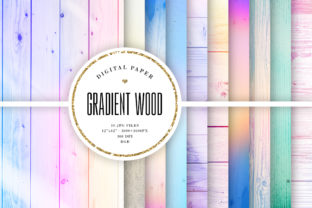
Elevate Your Visuals with Gradient Wood Backgrounds
When you are building a brand or designing a campaign, the foundation of your visuals matters just as much as the foreground text. You might have the perfect typography—a sharp sans serif font for headers or an elegant script font for accents—but if the canvas behind it feels flat, your message can get lost. This is where texture comes into play. Specifically, the warmth and depth of natural materials combined with modern color theory can transform a standard design into a tactile experience. That is the core promise of this collection of Gradient Wood Backgrounds.
This specific set of design assets is built for professionals who need high-quality textures without compromising on technical specifications. You are receiving 10 distinct JPG files, each with pixel dimensions of 3600x3600 and a print dimension of 12"x12". Because they are rendered at 300 DPI in RGB color mode, they bridge the gap between digital and print perfectly. Whether you are creating a website header or a physical poster, the resolution ensures your work remains crisp and professional. The "gradient" aspect is key here; it implies a shift in tone, usually moving from light to dark or blending colors across the wood grain. This adds a sense of motion and direction to a traditionally static material, making these files a premium font equivalent in the world of graphic resources.
The Visual Appeal of Organic Texture in Modern Design
There is a reason why "flat design" has slowly made room for more textured, "neo-skeuomorphic" styles. We crave realism. A Gradient Wood Background offers a specific personality that flat colors cannot replicate. It brings warmth, reliability, and an organic feel to your project. The wood grain provides natural lines that guide the eye, while the gradient coloring adds a contemporary twist. It stops the texture from looking like a stock photo of a floor and starts making it look like an intentional design asset.
Visually, these backgrounds work exceptionally well because of the contrast they offer. If you are working with a serif font for a luxury brand, the wood texture grounds the elegance, making it feel less sterile. If you are using a bold, geometric display font for a tech startup, the organic background softens the corporate edge, making the brand feel more approachable and human. It is a balancing act. The gradient element also helps with visual hierarchy. By placing your key text or logo design over the lighter or darker end of the gradient, you naturally draw the viewer's attention to the most important information without needing extra design clutter.
Practical Applications: From Social Media to Packaging
Understanding where to use these assets is just as important as the assets themselves. For social media graphics, these backgrounds are incredibly versatile. Platforms like Instagram and Pinterest are highly visual. A flat white background often gets scrolled past. However, a textured wood background with a subtle color gradient can stop the scroll. It creates a "thumb-stopping" effect that feels high-quality. It is perfect for quote graphics, product announcements, or "behind-the-scenes" content where you want to convey authenticity.
For packaging design, the application is obvious but effective. If you are a small business owner selling artisanal goods, coffee, or handmade crafts, using these backgrounds on your labels or box inserts connects your product to the concept of "handmade" and "natural." It reinforces your brand identity before the customer even opens the package. Similarly, in editorial design, such as magazine layouts or lookbooks, these textures can serve as full-page bleeds or sidebar accents to break up the monotony of standard paper textures.
Furthermore, consider the digital space. In web design, loading a full-resolution 3600px image might be too heavy, but scaling it down for a hero section or a background pattern works beautifully. It adds depth to a landing page, especially for lifestyle brands or creative agencies. Even for personal use—like digital planners, desktop wallpapers, or Zoom backgrounds—these files provide a polished, professional environment that reflects well on you during video calls or while organizing your digital life.
Integrating Gradients with Typography and Brand Strategy
A common challenge designers face is ensuring text remains readable over textured backgrounds. This is where the "gradient" feature of these wood backgrounds becomes a strategic tool. Unlike a uniform texture where the contrast is consistent, a gradient allows you to manipulate the environment to suit your typography.
If you are using a handwritten font or a script font, which often have thinner strokes, you should place that text over the smoother, lighter portion of the gradient. This ensures the intricate details of the creative font are not lost in the wood grain. Conversely, if you have a heavy, bold sans serif font, you can safely place it over the more textured, darker areas of the background. The weight of the font will stand up to the complexity of the wood pattern.
This interplay is vital for brand perception. Consistency in your visuals builds trust. If you use a chaotic background with illegible text, your brand looks unprofessional. But by using these high-resolution assets and carefully managing the color contrast, you project competence. It shows that you care about the details, which is a subconscious signal to customers that you will care about them, too.
Technical Specifications for Seamless Workflow
Let’s talk specs, because efficiency matters. You will receive 10 JPG files. Having 10 variations is a significant advantage. It allows you to maintain a consistent aesthetic across a campaign without being repetitive. You can use one texture for your Instagram Stories, another for your website footer, and a third for your newsletter header, all while keeping the "wood and gradient" theme intact.
The dimensions are 3600x3600 pixels, translating to 12x12 inches at 300 DPI. This is the standard for high-quality print output. Whether you are printing flyers, posters, or business cards, you will not encounter pixelation issues. The RGB color mode is also standard for digital-first workflows, but it prints well on modern digital presses. If you are working in a strict CMYK environment for offset printing, a quick conversion will usually suffice, though you should always proof your colors.
When selecting which of the 10 files to use, consider the "temperature" of the gradient. Some wood grains might have warmer, reddish tones, while others might be cooler, ashy greys. Match these to your existing brand identity color palette. If your brand colors are cool blues and greens, a grey wood gradient will harmonize better than a warm oak. This thoughtful selection process elevates your work from "using a stock photo" to "curating a visual experience."
Final Thoughts on Elevating Your Creative Toolkit
In the crowded landscape of digital content, standing out requires more than just good copy; it requires a visual language that speaks to your audience's subconscious. Gradient Wood Backgrounds offer a unique blend of the natural and the modern. They provide the texture and warmth that people connect with on an emotional level, combined with the clean, directional flow of modern gradients.
Whether you are a graphic designer looking for new textures, a marketer trying to humanize a brand, or a crafter wanting to professionalize your listings, these assets offer real utility. They are not just decoration; they are functional tools for readability, hierarchy, and mood-setting. By incorporating these into your workflow, you are investing in versatility. You are equipping yourself with resources that can adapt to a coffee shop logo one day and a high-tech product launch the next. That flexibility is the hallmark of a great design asset. Thank you for stopping by, and enjoy the creative possibilities these backgrounds will unlock for your next project.